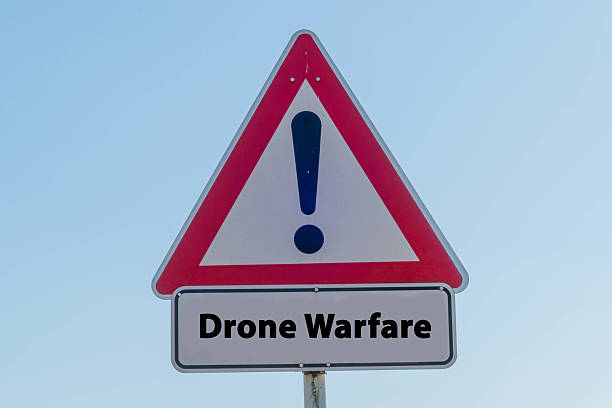
The Algorithmic Fog of War
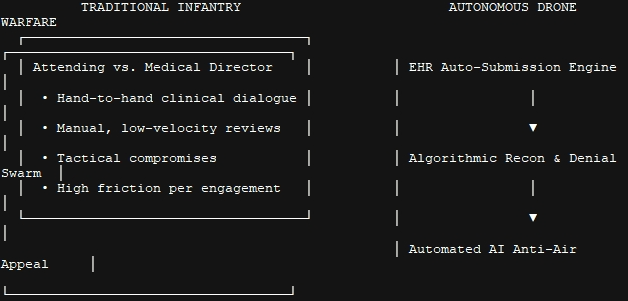
There was once a time—and you likely remember it with a mixture of nostalgia and mild hypertension—when the peer-to-peer review was hand-to-hand combat played by human beings.
It was an imperfect, boots-on-the-ground skirmish, certainly. A hospital attending or Physician Adviser would pick up the telephone to lock horns with a medical director at a commercial health plan. The medical director was usually a local physician who had retired from active clinical practice, too often in a specialty unrelated to inpatient medical care. You would argue over the necessity of admitting a frail septuagenarian with heart failure, a sodium level hovering in the low 120s, and a staircase at home that resembled an obstacle course.
You would cite the clinical nuance; they would cite the guidelines. You would drop subtle hints about medical liability; they would counter with InterQual criteria. Sometimes you won. More often you lost. But at the end of the day, two human soldiers with actual medical degrees had met on the battlefield. There was a person on the other end of the line—someone who, if pressed hard enough, could recognize the absurdity of sending a breathless patient home on a Friday afternoon. Someone you often knew and had local connections with.
That era of infantry engagement is largely gone.
In its place, utilization management has undergone the same dramatic shift that reshaped modern military doctrine: human combatants have been withdrawn from the front lines, replaced by autonomous drones, predictive algorithms, and automated defense networks operating at speeds that make human cognition look like a horse-drawn carriage on an interstate.
The pitch was seductive: surgical precision, minimal human exposure, and objective, data-driven decisions. Eliminate the emotional trauma of these interpersonal battles with each combatant accumulating battle scars in the process. The reality, however, is a relentless digital arms race that has escalated administrative warfare to an industrial scale—while managed care’s grandest promises of using sound medical principles to right-size medical care and “educate” clinicians in select and appropriate situations crumble under the weight of an endless assault from automated strike engines
Autonomous Swarms over the Battlefield
The fundamental shift in utilization management is not simply that software is reading charts; it is that software conducts reconnaissance and launches strikes at zero marginal cost.
When a medical review required a physician or a nurse auditor to open an electronic health record, scroll through nursing notes, scan lab trends, and render a decision, there was a natural speed bump built into the system. High friction acted as a tactical boundary. An insurer had to allocate finite human capital to review a claim, meaning they naturally focused their scrutiny on high-dollar and high-yield interventions.
Artificial intelligence eliminated the friction, replacing targeted infantry raids with autonomous drone attacks. Modern algorithmic platforms process thousands of inpatient charts in seconds. They orbit over every admission, every extended stay, every advanced imaging request, and every rehabilitation transfer, searching for subtle documentation anomalies that trigger automated rejections.
Reflex “copy and paste” regularly feeds this beast, which finds and relishes the inconsistencies that these notes supply in seemingly limitless fashion.
Predictably, health systems and their EHR’s did not simply surrender the airspace. Instead, they fielded their own automated counter-drone systems. Today, hospital revenue cycle departments routinely deploy counter-warfare – AI-
driven software to auto-generate appeals, deploy clinical countermeasures, and launch interceptors before the ink on a denial notice is metaphorically dry.
We have entered the era of bot-to-bot algorithmic warfare. A surveillance drone at the payer’s end flags an inpatient admission as “observation status” based on milliseconds of data parsing. In response, an automated defense battery at the health system’s end parses the same record, drafts a counter-appeal citing clinical guidelines, and fires it back into the payer’s portal.
Two autonomous systems are now locked in a perpetual dogfight over whether an elderly patient’s acute chest pain warranted an overnight bed—all while the patient sits in that very bed, completely unaware of the digital dogfight taking place above their telemetry monitor.
Moving Targets and Asymmetric Rules
Historically, coverage determinations were tethered to published, easily-referenced guidelines—Milliman Care Guidelines (MCG) or InterQual. While clinicians grumbled about these criteria, they were visible, like established terrain maps. You could look up the criteria for acute cholangitis, document the requisite parameters, and reasonably predict the outcome of the review.
Modern AI systems, however, operate like adaptive electronic warfare suites. They dynamically re-calibrate risk scores and denial thresholds using machine learning models trained on vast historical claims databases. Because these algorithms operate as black boxes, the coordinates for what constitutes a covered stay shift constantly:
- Evolving semantic targets: Documenting “acute renal failure” is no longer enough; the algorithm’s radar demands specific staging, etiology, and documented response to fluid challenges within a tight, dynamic window.
- Syntax over clinical reality: The system does not care that the patient looked terribly ill at the bedside; it cares whether the precise phraseology matching its internal reimbursement algorithm appears in the discharge summary.
- Shifting thresholds: Benchmarks for acute vs. observation status dynamically contract, turning standard medical management into an endless series of technical rejections.
This dynamic creates profound administrative shell shock for hospital reviewers and its revenue cycle management. It converts medical documentation into an exercise in counter-intelligence, where doctors write progress notes not to communicate with fellow caregivers, but to evade the secret interception criteria of a remote algorithm.
The Collateral Damage Shell Game
The central justification for automating utilization management has always been cost containment: by curbing unnecessary care, health plans supposedly reduce the total cost of healthcare.
It is a persisting narrative for justifying this tremendous infrastructure. It is also, from an economic standpoint, an illusion – akin to measuring the success of a war solely by the number of artillery shells fired.
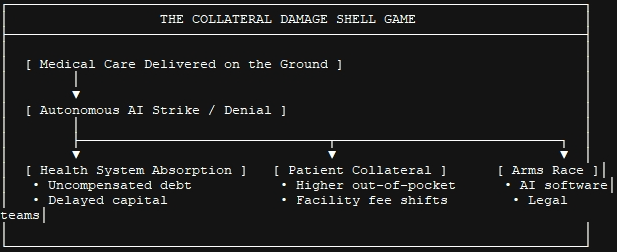
Voiding a claim and denying payment by an algorithm does not eliminate the underlying expense of the care that was already delivered. When an autonomous system converts an inpatient stay to observation status, the clinical resources—nursing hours, surgical suites, medications, physical therapy—have already been consumed by the hospital.
The Cost Paradox
The administrative apparatus required to sustain this drone warfare is staggering. Payers spend billions building larger AI denial engines; health systems spend billions buying counter-AI software and armies of legal auditors to fight those denials. Instead od cost savings, this silent background warfare is adding billions of dollars of administrative coast to the system. So who is funding this “negative savings” account.
Who pays
When an algorithm denies a claim, it does not erase the resources expended. It simply redistributes the financial collateral damage:
- Shift to the Civilian (Patient): Inpatient stays reclassified as observation status subject patients to higher out-of-pocket facility fees, variable copays, and uncovered drug costs. The overall cost remains unchanged; the financial shrapnel simply hits the patient.
- Shift to the Base (Health System): Denied revenue transforms into hospital bad debt or uncompensated care, forcing health systems to inflate charge masters or negotiate higher baseline commercial rates to survive.
- Shift back to the Insurer: The ultimate irony of automated medical review is that all the “hits” the hospital takes up front wind up being the cost basis for the next round of hospital negotiations with their local and national insurers. And the sticker shock recurs for everyone purchasing health insurance.
Standing Down the Machines
Where does this leave us?
We find ourselves trapped on a battlefield governed by automated systems. On one side, the Electronic Health Record forces us into rigid documentation formats; on the other, payer algorithms scan those records to shoot down reimbursement. Clinical judgment is increasingly caught in the crossfire of two automated systems optimizing cash flow rather than clinical outcomes.
Yet, as the noise of this algorithmic war grows deafening, a counter-movement is beginning to take shape:
- Legislative Demilitarization: Federal and state lawmakers are targeting “black-box” denials, introducing legislation that mandates human oversight, transparency in algorithmic models, and bans on batch automated rejections.
- Algorithmic Accountability: Medical societies are demanding that AI tools used to deny care undergo rigorous, transparent validation—holding them to the same safety and efficacy standards as medical devices.
- Re-establishing Human Command: There is a growing consensus that true value in medicine cannot be calculated by radar. The complex, messy realities of human illness refuse to fit neatly into an automated decision tree.
The challenge for the medical profession over the coming decade is not to banish technology, but to enforce strict rules of engagement. AI belongs in the field as an aid for diagnostic imaging, risk stratification, and scientific research. But as an arbiter of clinical necessity and human care, an algorithm is a poor alternative to medical discussions among knowledgeable professionals.
The next time you see an automated denial generated in milliseconds by a server farm, remember: you are not losing an argument to a superior mind. You are simply watching an expensive drone hover over a hospital bed—and it remains our responsibility, as physicians, to step in and defend the human being lying inside it.